Barry Riley reflects on finding spiritual space in a busy world.
In the opening paragraph of his latest Encyclical Letter Fratelli Tutti Pope Francis quotes his namesake St Francis of Assisi as declaring blessed all those who love their brother "as much when he is far away from him as when he is with him". The Pope expresses concern that the world today is becoming more divided. "In some countries a concept of popular and national unity influenced by various ideologies is creating new forms of selfishness and a loss of the social sense under the guise of defending national interests."
He adds that the slow and demanding march towards an increasingly united and just world is suffering "a new and dramatic setback". He repeats an observation he made in 2019. "Once more we encounter the temptation to build a culture of walls, walls in the heart, walls on the land, in order to prevent this encounter with other cultures, with other people. And those who raise walls will end up as slaves within the very walls they have built."
The Pope's wise words are not always welcomed, however, by various nations and cultures. Today, more humans are on the move across national borders than at any time since the exceptional circumstances at the close of the Second World War. Imbalances in the world's population have become serious and are likely to become more severe. It is not a problem that religious leaders find it easy to deal with.
Go Forth and Multiply?
Parents decide, but priests feel unable to stand aside. Rising population levels never used to be a problem. After all, in the Book of Genesis God gave the Earth to mankind, saying: "Be fruitful, multiply, fill the Earth and conquer it." But that was in the context of an empty landscape full of promise and potential and previously populated only by scattered tribes. Nevertheless there could still be painful battles for the best living space although as hunter-gatherer cultures were replaced by settled agricultural practices the land could accommodate many more people. Today, however, the global human population has risen to 7.8 billion. Surely the Earth has already been filled.
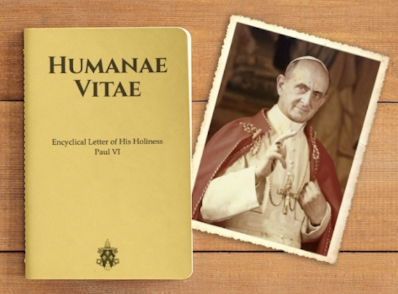
In the modern era The Catholic Church first addressed this issue in Humanae Vitae, Pope Paul VI's Encyclical Letter in 1968. It began: "The transmission of human life is a most serious role in which married people collaborate freely and responsibly with God the Creator". The encyclical went on to say that responsible parenthood should be exercised "with regard to physical, economic, psychological and social conditions". The encyclical was published at a time when pressures on the world's resources were becoming a serious cause for concern, though the global population was under 4 billion at the time. In the same year 1968 the Club of Rome was founded: it had no very close connections with the Church of Rome but its founders were deeply concerned with the problems of resource depletion, at a time when there were widespread doubts about whether food output could keep pace with the growth of the human population.
As it turned out, in the ensuing decades the world's farmers and agronomists did a wonderful job, if at a significant and increasing cost to the environment. New plant varieties, more fertilisers, much more input of energy and a great deal of hard work pushed back the threat of mass starvation. But the perceived problem then shifted. By the time Pope Francis produced his Encyclical Letter Laudato Si' in 2015 the greatest concern did not concentrate on the inadequacy of harvests but on environmental damage, part of which related to the very success of agriculture. He explained: "Now, faced as we are with global environmental deterioration, I wish to address every person living on this planet."
Pope Francis did not, however, focus primarily on the rapid growth of population. He emphasised instead the gap within the global population between the rich and the poor. "To blame population growth, instead of extreme consumerism on the part of some, is one way of refusing to face the issues," he wrote. The wealthier members of the world's population, he implied, should reduce their living standards in order to make environmental room for the growth of the population in poorer countries. It was a simple message that the rich should pay for the poor, but a theme that was never going to be popular in wealthy countries.
Only a very few years later, however, in 2020, the focus of global population concern is shifting again. Rich countries are seeing reductions in their birthrates: the populations of countries including Japan, Russia, Germany and Italy have begun to fall and some academics predict that there will be substantial declines in their numbers of inhabitants during next few decades. At the same time, however, birthrates in many poorer countries across Africa and the Middle East remain high. More and more of these countries are incapable of finding worthwhile economic opportunities and life chances for their many millions of young people, especially the men. One consequence has been political instability in many countries across these regions; during the interminable Syrian civil war it has been tragic to see so many children falling victim to the violence, but they are not simply peripheral victims, they are in a very real sense an important cause of the instability.
The fertility rate determines the rate of population growth. If the rate is around 2.1 babies per mother the population will be stable in the long term. According to the University of Washington's Institute for Health Metrics the global average fertility rate back in 1950 was 4.7, leading to a rapid expansion of the global population. But in many countries the rate has since declined substantially, so the average has fallen to around 2.4 worldwide. In many parts of the world, therefore, populations may even have begun to decline. The problems of the future therefore will not be dominated by pressures on resources but rather on the societal stresses resulting from the changing balance between the numbers of young and old.
That may be the global picture but it is not a uniform pattern. In North Africa and the Middle East the fertility rate is more like 2.7 while in sub-Saharan Africa it is 4.6. A selection of countries with especially high rates includes the Democratic Republic of the Congo, with 5.0, Chad, with 6.7, Afghanistan with 6.0, Sudan with 4.2 and Iraq with 3.8. These are all countries racked by political instability. On the other hand the fertility rate in Syria has been only 2.2 so a high birth rate is by no means the only generator of revolution and unrest.
We now, therefore, can discern a new global problem. Too many countries are producing more children than they can accommodate economically, socially and politically. This creates instability and poverty. As a consequence young people are spilling out across frontiers. This is not, of course, an entirely new phenomenon but it is on a very large scale. They migrants may be fleeing from civil wars and revolutions or simply seeking to escape from poverty. In the end, some of them have begun to turn up at Calais and board rubber boats in order to reach Britain, aided by so-called "people traffickers", an unnecessarily abusive name for operators who are no more than travel agents acting for clients who lack all the required legal documentation. Although the tabloid newspapers in Britain are angry at such an invasion it is a small problem so far for this country. But the future may be very different: the real danger is that we are seeing just the very beginning of a war of surplus populations which will involve the movement of people on the scale of tens of millions.
Uneven population growth
There is a topsy-turvy aspect to this potential crisis of differential population growth. It might be thought that wealthy nations would tend to produce more children than the poor nations which cannot easily afford them. But that is not at all how it works. In rich societies children become very expensive, partly because of the costs of educating them and partly because caring for them limits the earning power of the parents, especially the mothers; there is a huge opportunity cost. In poor countries, however, children cost much less to bring up and they may also be put to work very young. Moreover, crucially, a large family also represents the prospect of old age protection for parents living in countries where national systems of social security are inadequate or even do not exist. In countries such as India barrenness is regarded as a personal tragedy.
Should the Roman Catholic Church have something to say on this enormously important subject? We surely need a moral framework to help parents to decide how many children to create. But this issue was ducked by Humanae Vitae which recognised, however, that excessive population growth would have the consequence that "many families and developing countries would be faced with greater hardships". The Encyclical said that the transmission of human life was a most serious role in which married people collaborated freely and responsibly with God the Creator.
Instead of pursuing this theme, however, the encyclical became bogged down with obscure arguments about natural law and the differences between natural methods and the use of artificial contraceptives. The Church, it appeared, was trying to create purely technical obstacles to the exercise of parental judgement.
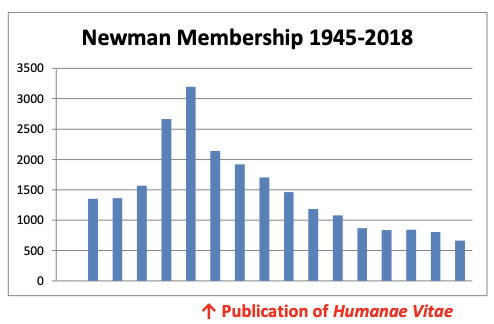
The refusal of the Vatican to leave responsibility in the proper control of married parents infuriated many members of the Newman Association at the time. Indeed membership collapsed and the damage done then has never been adequately repaired. Celibate priests seemed to be extending their Magisterium into areas where they had no natural mandate. But the Encyclical insisted: "No member of the faithful could possibly deny that the Church is competent in her magisterium to interpret the natural moral law." In fact the encyclical in the course of time undermined the authority of the Church because its edicts have been widely disobeyed, judging by the way that birth rates have subsequently fallen in mostly Catholic populations in much the same way as amongst non-Catholics, at least in wealthier countries. Nearly fifty years later, in Laudato Si', Pope Francis was forced to avoid the question again because the Church had, in effect, torn up its options on population control. He chose to focus instead on the clash between wealth and poverty. The topic of rapid, and potentially destabilising, levels of population growth in developing countries remained unaddressed.
How parents decide their family size is a many-layered question. To begin with, it is a matter of the natural level of fertility which varies from couple to couple. It is also influenced by the age of marriage, which is an important factor in Africa where many brides are still in their teens, but which is a negative factor in many western countries where few brides nowadays marry before they are 20 years old (and in Britain the average age of first marriage for brides is currently 31.5). Financial considerations can also be important, especially in wealthier countries where the costs of bringing up a family can be very high. Lack of easy access to contraceptive methods may also be a factor, with the result being a higher average birth rate in developing countries even though poverty is a critical problem for young families.
One of the most important influences, however, must be the behaviour of the peer group. Big families were very common in Ireland, for instance, until the middle of the twentieth century but they no longer are. Large numbers of children could be welcomed as the product of love and commitment, as a manifestation of God's Will. But this is rarely so today. Too many babies are regarded by the Daily Mail as a sign of benefit-scrounging and even prime ministers can face criticism if they father a large number of children.
The two biggest global religions, Christianity and Islam, apparently remain committed to high levels of population growth. The more people there are, the better: and a more worrying subtext is that higher birthrates will increase the dominance of members of such denominations (always assuming that the youngsters will keep the faith). The Pew Research Centre, a Washington think tank that focuses on many social issues, including religious themes, published a report in 2017 that projected a strong rise in the number of Muslims. It estimated that Muslim women bear an average of 2.9 children, compared with 2.6 for Christian mothers and just 2.2 for the average of all non-Muslims. As a consequence Muslims, who made up an estimated 24 per cent of the world's population in 2015, could account for 31 per cent of the total in 2060, by which stage Islam could have more adherents globally than Christianity.
Such a trend is hard to explain through doctrinal factors. But differences in fertility rates are creating political pressures through population shifts in various countries. In India, for example, the Islamic population is growing faster than the Hindus. In Nigeria a rough balance between Christians and Muslims is shifting towards a Muslim majority. The most explosive consequences of differential birthrates have arisen in Myanmar where the Muslim Rohinya minority were accused of heavily outbreeding the Buddhist majority. Possibly as a result the Rohinya were aggressively persecuted and eventually driven out of Myanmar, although the facts about relative birthrates were obscure.
The Muslim influence seems to be apparent in the high birth rates which are being recorded in large parts of the Middle East and Africa, where Islamic adherence is at a high level. Curiously, though, the hardline Muslim state of Iran has a fertility rate of only 1.7, so national culture and politics seem to matter at least as much as religion.
Africa is now at the centre of global population growth. Perhaps this is nothing very new, since the human race is thought to have first emerged in Africa. About 100,000 years ago humans began to migrate northwards and eastwards to Europe and Asia, reaching Australia perhaps 50,000 years ago, but then taking a very long time to reach the Americas, which began to be colonised only about 15,000 years ago. Today Africa is the home of roughly 1.3 billion people, a sixth of the global total. But with the average mother in Africa bearing 4.7 babies the population could double by 2050, a period in which populations in much of Europe and Asia are likely to fall. Nigeria already has 200 million people and with a fertility rate of 5.1 the population is exploding: by 2050 it could be the third-biggest country in the world by number of people and by 2100 the population could reach 700 million if the trend continues – although, of course, it probably will not.
After 100,000 years people are still migrating northwards out of Africa and the numbers are increasing. For several years now large numbers of migrants have been gathering on North Africa's Mediterranean coastline aiming to reach Europe. Some of them have been travelling further through Europe to the Channel coast of France. There, the French do not want them and so do not greatly interfere with the plans of many of them to travel on to the English South Coast. The first option for the migrants has been to board trucks heading for the Channel Tunnel or ferries. The British authorities, by tightening security procedures, have over the past year or so made this more difficult, so the preferred solution for many of the migrants during the summer of 2020 has been to crowd on to flimsy boats in order to cross the Channel whenever the weather has been calm.
Should the Christian Church have anything to say about this imbalance of the European and African populations? The lead in this debate has been seized by atheistic organisations such as Extinction Rebellion which has developed some of the concerns raised in Laudato Si' about environmental damage and has turned them into an aggressive activist programme. Many more moderate young people are also desperately worried about what will happen to the global climate during their lifetimes. These concerns led to the establishment of a movement called Birthstrike, a voluntary organisation for women and men who feel that they should not have children in the context of the threatened climatic breakdown. These are people who experience moral imperatives even though they have no very clear religious beliefs.
Of course, there is no indication that African mothers and fathers are focused on similar ethical issues. Why are Africans producing so many children? Probably they are responding to immediate cultural pressures and to the favourable economic conditions in many countries. There are climatic problems, as the Sahara desert creeps southwards and other droughts persist in places such as Zimbabwe. But in difficult economic circumstances it may seem natural to bear more children rather than fewer. They are, after all, the greatest form of investment in the future.
When populations shrink
The latest demographic projections in any case present a very different message. In many wealthy countries the birth rate has fallen well below the level of about 2.1 children per mother which promises stability of the total population. This is not an entirely new problem: in France the population fell in the 1930s and the government of the time introduced the code de la famille which provided financial incentives for larger child numbers. As in many other Western countries there was a post-Second World War baby boom in France, but today the birth rate there is only 1.8 and in Germany it is just 1.4. If this trend continues for very long into the 21st century then there will be severe societal and economic consequences. Far from resisting the influx of surplus people from Africa these countries in Europe and Asia may soon face an urgent need to encourage immigration despite daunting barriers of culture, prejudice and religion.
It is a confusing situation and perhaps it is not surprising that BirthStrike, which was founded in 2018, appears to have ended its campaign in September this year. The reasons for its retreat are not entirely clear, but its organisers appear to have feared that the movement's intentions were being misinterpreted. It had blundered into a toxic area of racial hostility. Most of the group's social media outlets have been deleted.
The birth rate is certainly a politically hazardous subject. Do people have a "right" to produce as many children as they wish or do they, perhaps, have a "duty" to moderate their number of births in accordance with economic or social capacities? Or, indeed, a responsibility to produce more children when the fertility rate has fallen below 2.1?
There are potent racial aspects when the largely black population of Africa is spilling over into mostly white Europe. Racial tension is high at present in many countries, not least in the United States. There is also the tension between the rich and the poor, as Pope Francis has highlighted. Should the poor cease having so many children because they cannot really afford them? This can easily turn into an argument for the oppression of the poor. Overriding all this is the ecological imperative as mankind faces global warming and a potential climatic catastrophe.
A threat of extremism
Pope Francis expressed strong views in Laudato Si'. But they were nothing compared with the aggressive posture of movements led by Extinction Rebellion, which although not institutionally religious is in some respects turning into a new kind of atheistic doctrine-based entity. There is the deeply worrying prospect that eco-extremism will intensify to the stage that normal ethical standards become abandoned. The end will be seen to justify the means. This is the route travelled far too often in the past by religions which have relied on persecution and oppression in order to eliminate rival beliefs.
The menacing growth of fear and hostility is addressed by Pope Francis in his new Encyclical Letter Fratelli Tutti. "I realise that some people are hesitant and fearful with regard to migrants," he says there. "I consider this part of our natural instinct of self-defence. Yet it is also true that an individual and a people are only fruitful and productive if they are able to develop a creative openness to others. I ask everyone to move beyond those primal reactions." He adds: "Fear deprives us of the desire and the ability to encounter the other."
These are wise words but they may not be as powerful as the appeals to identity and culture which dominate the campaigns of populist politicians. How can the world cope with disruptive differences in birth rates and the growth of population? Pope Francis may now be too advanced in years to approach these daunting fundamental issues. We will have to wait for a new Pope to integrate the responsibilities of parents into the awesomely complex framework of ecology, population and global politics. It is at root a question, as Humanae Vitae described it, of how married people "collaborate freely and responsibly with God the Creator".
Barry Riley is a member of the Ealing Circle and is Editor of The Newman