An edited version of the Manchester Newman Lecture given at Friends' Meeting House on April 25th 2016. Paul Vallely examines the reform agenda of Pope Francis, the resistance it has provoked, and what Amoris Laetitia reveals about the Pope's vision for the Church.
This is an edited version of the talk given at Friends' Meeting House, Manchester, on April 25th. The full text is available on the Newman Association's website.
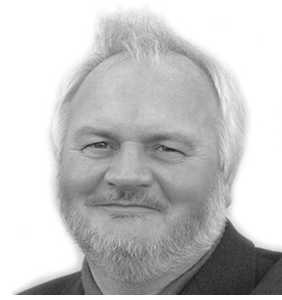
Paul Vallely
Recently1 the Jesuit university in New York, Fordham, held a public discussion entitled "Is the Pope Catholic?" The phrase has long been used in American colloquial speech as a dismissive response to a silly question. Thus, Question: Would the kids like to go to Disneyland? Answer: Is the Pope Catholic? But as the Fordham discussion shows, what was once a piece of puerile rhetoric has become a serious question.
A number of prominent Catholics are seriously asking: "Is the Pope truly Catholic?" Hard-line conservatives have long resisted the changes being ushered in by Pope Francis. They didn't like it when he washed the feet of women, and Muslims. They didn't like it when he said the Church has been too "obsessed" (to use his word) with issues like abortion, gay marriage and contraception – and he shifted the focus of the church from sex to social injustice: "How I would like a poor Church for the poor". They called Evangelii Gaudium, his 2013 apostolic exhortation, Marxist for its critique of capitalism and condemnation of "the idolatry of money". They told him to stop meddling with science when his landmark eco-encyclical in 2015 Laudato Si' accepted the scientific consensus that human activity is at least partly to blame for climate change. They didn't like it when he ruled out any campaigns to convert Jews and approved a "common prayer" with Lutherans for joint commemorations for next year's 500th anniversary of the start of the Protestant Reformation.
Catholic identity
All this, they said, was spreading "confusion". Confusion is the codeword among Conservative Catholics for anything the Pope says that they disagree with. But they are not actually confused: just annoyed and upset that Pope Francis raises questions over what they have, in the era of Pope St John Paul II and Benedict XVI, held as axiomatic badges of Catholic identity. "Who am I to judge?" riposted Francis, when asked about a gay person who seeks the Lord, answering a question with another question. Questions have not been very fashionable in the Vatican in recent decades: only answers.
But the Pope's latest offering – the 2016 apostolic exhortation, Amoris Laetitia, The Joy of Love – has moved the attacks upon him up a gear, and seriously so. The Pope's document on family life has been branded "a catastrophe2," "a deliberately destabilizing document3" and "an abuse of the Pope's teaching authority [which]… will no doubt be a source of confusion, media spin, and continued crisis within the Catholic Church4". One US conservative wrote: "Suddenly the rhetorical question, 'Is the pope Catholic?' doesn't seem so rhetorical anymore5". The influential New York Times columnist Ross Douthat, who has been one of Francis's leading critics on the Catholic right, is openly wondering about the pontiff's doctrinal purity and whether he is leading the Catholic Church into schism6.
I'll look at The Joy of Love in more detail later. But what has so riled conservatives about it? After all, it is a document which, as they acknowledge, clearly reiterates Church teaching on contraception, abortion, the right of medics to refuse to be associated with abortion, the right of children to have a mother and father and the fact that a same-sex union is not analogous to marriage? What has riled them is this: Pope Francis may not be changing Church teaching but he is dead set on changing the culture of the Church. He wants the Gospel to feel like Good News. He wants the Church to open its arms to embrace what is positive in people's messy lives rather than wagging its finger at what is negative. What the conservatives don't like is that Amoris Laetitia says we should stop saying that gay or remarried people are "living in sin". Or that we should see seeds of goodness in even so-called "irregular" situations. All this, says Ross Douthat, has been "designed to introduce a level of ambiguity into Church teaching".
My focus tonight is going to be on what I see as Francis's central reform, which is about process – not outcomes. This Pope wants to change the way in which the Church makes its decisions; he wants it to abandon the modern monarchical model of papacy and replace it with the more collegial and consultative decision-making process which characterised the early Church, and to which the Second Vatican Council wanted the Church to return, so that the Pope and the Vatican become the servants of the Church rather than its master.
But it is worth nothing in parentheses that this dynamic of reform and resistance is not confined to this single area, crucial though it is to Francis's mission.
As we have seen in the recent days there is resistance, too, to Pope Francis's push to clean up the Vatican's finances. This is an area in which Cardinal George Pell, the Vatican's senior money man, has made huge progress. Yet only last week another department, that of the Secretariat of State, has told all Vatican departments to ignore the international accountancy firm, PricewaterhouseCoopers, brought in by Pell's Secretariat for the Economy to do an external audit of the Vatican finances. Exactly what is going on is obscured but what is clear is that this is a setback for Cardinal Pell's reform process. There is talk of: deliberate attempts to humiliate Pell, whose vigorous reform process was resented by the old guard in the Curia, the Vatican bureaucracy; of the audit unnerving vested interests; of moves to oust the reforming president of the Vatican Bank; and even to get Pell replaced. Some talk of open civil war in the Curia. But at the very least the level of resistance is clear, and seemingly becoming more overt.
Then there is the issue of sexual abuse. There is the same dynamic of reform and resistance there. I'm going to be talking about that at length in my lecture at the Sale Festival on 16 June. But, briefly, a hidden civil war which has been waged inside the Vatican for the last two years continues. On one side are reformers who want public accountability for paedophile priests and the bishops who oversee them. On the other is the recidivist Roman old guard whose instinct for cover-up continues. Two years ago Francis set up the Pontifical Commission for the Protection of Minors. It is made up of clerics, theologians, psychiatrists, therapists and – most significantly – two survivors of priestly sex abuse. The most vocal of them was Peter Saunders, who founded the National Association for People Abused in Childhood, and who is one of the world's most forthright anti-abuse campaigners. When Francis chose him to join the papal panel it seemed that real change was in the air in Rome.
Yet in February he was asked to leave the Commission. It was a signal that the Catholic Church is reverting to its old bad habits of secrecy and cover-up. At the same time it was revealed that the Church has been running training courses for new bishops where they have been told it is "not necessarily" their duty to report accusations of clerical child abuse to the police. The commission, it transpires, had been allowed no role in devising the training programme. At its last meeting it heard how two priests recently alerted their bishop to an abuser priest – and were then were told by the bishop to stay silent. The tribunal set up inside the Congregation for the Doctrine of the Faith to prosecute bishops who covered up for paedophile priests has not heard a single case yet. Another commissioner, Marie Collins, has announced her lack of confidence in "those whose task it is to work with us within the Vatican and implement our proposals when approved by the Pope".
Opposition to reforms
So there is a pattern here. Francis wants reforms; those who oppose them drag their feet or create bureaucratic obstacles. It is there in finance. It is there on sexual abuse. It is there on reform of the Curia. But it is most threatening to the Francis Project in the area I now want to address in detail.
The 2014 Synod marked a new chapter in the history of Catholicism. A first step had been taken in significantly shifting the way in which the Church governed itself. Bishops had openly discussed ideas for which they could have been investigated, censured, silenced or removed from office under previous papacies. The climate of conformity and fear that had gripped Catholicism had lifted. But the price of that was that it allowed the first mainstream public opposition to Pope Francis to emerge. Some critics became fierce in their attacks on him in the weeks that followed. But Pope Francis seemed unfazed.
He told the Argentinian newspaper, La Nación7: "Resistance is now more evident. But that's a good sign for me. It's out in the open and there is no stealthy mumbling when there's disagreement. I am not worried. It all seems normal to me. If there were no difference of opinions, that wouldn't be normal." And he continued: "You could ask me, 'Are there any individuals who are completely obstinate in their positions?' Yes, there surely are. But that doesn't worry me. It's a question of praying for the Holy Spirit to convert them, if there are such people. The prevailing feeling was a brotherly one."
The net effect of all this was that the 2015 Synod began with an atmosphere which was far from the brotherly one of which Francis had spoken at the end of the 2014 gathering. There was a lot of suspicion and bad faith about. On the eve of the Synod reports began to circulate that Pope Francis had a benign brain tumour8 – reports which several senior cardinals decried as a deliberate attempt to undermine the Pope by implying that his mental acuity was impaired. Then came reports – of varying degrees of accuracy – of 13 senior cardinals writing to the Pope on the opening day of the Synod warning him against any attempt by reformers to manipulate the Synod's working document, procedures or membership of the group charged with writing the final report9.
The Pope himself felt obliged to make some unplanned opening remarks at the synod cautioning its members against buying into what he called a "hermeneutic of conspiracy". Such fears, the pope said, are "sociologically weak and spiritually unhelpful." But it was not the most auspicious start to the gathering10.
The final document which the 2015 Synod produced was more cautious than the text of 2014 which is perhaps why it received the quorum consent of a two-thirds majority for all its paragraphs. In that sense it gives us a picture of the Church – or more accurately, of its bishops – as the Church presently is, rather than the Church as Pope Francis would like it to be. For all that, it is some considerable achievement to have got as far as he has given that almost all these bishops were appointed by Wojtyla and Ratzinger. The final Synod document contained something to please everyone, even if few seem completely satisfied with the final delicate compromise – which took the most controversial issues off the table or treated them with ambiguous language. The result allowed conservatives to insist that nothing had really changed, and that therefore they had won11, while liberals asserted that the door had been opened to significant change on the totemic issue of readmitting divorced and remarried Catholics to Communion12. The secular media, trying to take the even-handed approach, were unable to decide13.
But what was important about the Synod was not the outcome: it was the process. And the changes there produced significant changes in mood, tone and language. Beforehand, although the Church stoutly maintained that it loved the sinner but hated the sin, yet the plain truth is that for all the previous talk of "respect" gay people have in practice been treated with hostility for decades by many in the Catholic Church. Francis's Synods are the first in which the word "gay" has been used. (One cardinal told me that they are also the first Synods in which laughter has been heard). Even the phrase "homosexual unions" is an implicit acknowledgement of a reality more conservative Catholics would be at pains to ignore. In the second Synod there was no talk about homosexuality being "intrinsically disordered" or a "moral evil". Such talk, many in Rome suggest, is now permanently over. And there were even a handful of women allowed, as a token gesture. This Pope says we need a new theology of women, but he's not sure how to go about it.
Amoris Laetitia
It is on that shift which Pope Francis has built in Amoris Laetitia. The Joy of Love is an extraordinary document. It is another expression of the deep message of compassion and mercy which have become the hallmark of this Pope. Francis is a Pope who is orthodox on doctrine but revolutionary in his application of it, a Pope who puts the Gospel – and a vividly merciful expression of it – before dogma. And a Pope who believes that mercy is a higher Gospel virtue than judgement or condemnation.
So Amoris Laetitia is a document filled with traditional language which reaffirms Catholic teaching unequivocally on issues such as on abortion and the relative merits of heterosexual or same-sex marriage. But it speaks plainly about a wide range of complex pastoral challenges to the family. The long text calls for better sex education for the young, advises engaged couples to spend less on their weddings, calls for parishes to support young marrieds and tells men to do more housework. It looks at challenges facing the family, ranging from war and migration to unemployment and a lack of affordable housing.
But on the controversial issue of lifting the ban on remarried Catholics taking Holy Communion it is ambiguous. It reiterates Francis's Evangelii Gaudium pronouncement that the Eucharist "is not a prize for the perfect, but a powerful medicine and nourishment for the weak." And it speaks of the so-called "internal forum" in which a priest or a bishop may work with a Catholic who has divorced and remarried to decide privately and on a case-by-case basis if he or she can be fully re-integrated into what he calls "a fuller participation in the life of the Church".
There is a wilful ambiguity in this. The language is elastic. It allows conservatives to find in it unequivocal affirmation of the indissolubility of marriage. Yet liberals can see repeated distinctions between doctrinal ideals and pastoral compassion – condemning the sin but loving the sinner; the Pope dismisses phrases like "living in sin" insisting sin cannot determined by a scrutiny of external circumstance. Not everything that looks "irregular" has sin in its heart.
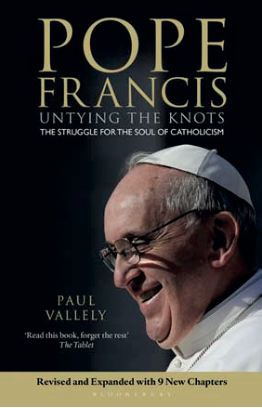
What this means in practice is that Amoris Laetitia will be seen as giving conservatives permission to change nothing at all. Those pastors and bishops inclined to a stricter reading of Church law will not feel compelled to revise their thinking. Indeed they can point to this document as justification for not changing their behaviour at all. And yet the exhortation also allows those more pastorally inclined to point to the same document as justifying change. In many places, far more so in the UK, the "internal forum" is already applied. In many parishes, divorced and remarried Catholics go forward for communion, and many priests either quietly encourage them to do so or, at least, never discourage them, choosing to respect whatever decision they have made in conscience.
Ecclesial revolution
Yet to say that Amoris Laetitia leaves much open to interpretation misses the point of what is really revolutionary about this apostolic exhortation. For I submit that the seeds of a significant ecclesial revolution exist within this document. To understand that we need to look again at process, not outcomes. Pope Francis does not want to change the rules. He wants to change the culture in which those rules are applied.
Consider these passages from the document:
There is a need to avoid judgements which do not take into account the complexity of various situations. Amoris Laetitia, Para 296
The divorced who have entered a new union… should not be pigeonholed or fit into overly rigid classifications leaving no room for a suitable personal and pastoral discernment. (Para 298)
One size does not fit all. He makes that clear at the start of the exhortation. People are encouraged to live by the Gospel, but should also be welcomed into a Church that appreciates their particular struggles and treats them with mercy. Church teachings are universal but they can and should be interpreted with flexibility in different circumstances, places and time:
Each country or region, moreover, can seek solutions better suited to its culture and sensitive to its traditions and local needs. (Para 3)
Not all discussions of doctrinal, moral or pastoral issues need to be settled by interventions of the magisterium. (Para 3)
That is Rome, the Vatican and the Pope do not need to decide everything. And he returns to that in Chapter Eight, the section of Amoris Laetitia which is headlined: "Accompanying, Discerning And Integrating Weakness". There he says:
Neither the Synod nor this Exhortation could be expected to provide a new set of general rules. (Para 300)
It can no longer simply be said that all those in any "irregular" situation are living in a state of mortal sin (Para 300)
A pastor cannot feel that it is enough simply to apply moral laws to those living in "irregular" situations, as if they were stones to throw at people's lives (Para 305)
By thinking that everything is black and white, we sometimes close off the way of grace and of growth (Para 305)
Priests must avoid "the closed heart of one used to hiding behind the Church's teachings, sitting on the chair of Moses and judging at times with superiority and superficiality difficult cases and wounded families". (Para 305)
Most forcefully he adds, quoting in a footnote from Evangelii Gaudium:
"I want to remind priests that the confessional must not be a torture chamber, but rather an encounter with the Lord's mercy." (Footnote 351)
Pope Francis knows that not everyone will agree with this view and says that he understands those who "prefer a more rigorous pastoral care which leaves no room for confusion." (Para 308)
However, he adds:
"I sincerely believe that Jesus wants a Church attentive to the goodness which the Holy Spirit sows in the midst of human weakness, a Mother who, while clearly expressing her objective teaching, always does what good she can, even if in the process, her shoes get soiled by the mud of the street." (Para 308)
What all this is doing is asking the Church to meet people where they are, to consider the complexities of people's lives, to give them guidance, and to respect people's consciences when it comes to moral decisions. Some conservatives immediately declared themselves to be "confused". Others, like the arch-traditionalist Cardinal Raymond Burke, pronounced that Amoris Laetitia was not a definitive teaching document but just the personal opinion of Pope Francis. But others pointed to what the Pope had said when quizzed by the press about the meaning of the footnote on Communion.
On the Papal Plane
Had anything concrete changed they asked him at an inflight press conference in April on the papal plane back from his visit to Syrian refugees in Greece. "Read the presentation14 by Cardinal Schönborn, who is a great theologian," the Pope said. Cardinal Christoph Schönborn of Vienna had introduced Amoris Laetitia at its official launch in the Vatican. He said it represented what he called an "organic development" of the Church's pastoral practice for remarried divorcees. Afterwards he said the document had adopted his 5-step programme in Vienna15. The programme involves a series of five questions a priest must ask divorced and remarried couples to see how mercifully and correctly they have behaved before, it can be inferred, they are able to receive Holy Communion. This was, one prominent conservative canon lawyer16 complained afterwards, "the Kasper proposal" in disguise, adding: "We have something here which is not in accord with what the Church has said up till now".
So why do I say all this contains the seeds of a significant ecclesial revolution? Let me tell you a story. One sleepy Sunday a friend of mine was with a group of English priests in a car taking a drive in the country just outside Rome after lunch. Few people were around. Only mad dogs and Englishmen go out in the midday sun. The road entered a little village where all was quiet. But the traffic light was on red. So the Englishmen stopped. A few moments later a car came up behind them. Its Italian driver overtook them and edged forward through the red lights. The Englishmen sat law-abiding and stationary. Another car did the same. The Englishman continued to obey the red light. Then, finally, it changed. As it did, one of the priests turned to my friend and said: "So now do you understand the Italian attitude to Humanae Vitae".
The veteran Vatican-watcher John Allen wrote something reflective a few weeks after Amoris Laetitia was published. He wrote: "What Pope Francis has done is let the rest of the world in on one of the best-kept secrets about the Catholic Church. Yes, the Church has laws, and it takes them very seriously. But even more than law it has flesh-and-blood people, and it takes their circumstances and struggles seriously too. For Mediterranean cultures, which still shape the thought-world of the Vatican to a significant degree, law is instead more akin to an ideal. It describes a moral aspiration, but realistically it's understood that many people much of the time will fall short. In reality, that's been the spirit of things in the Church forever, to greater and lesser degrees depending on time and place. Still, it somehow feels new, and important, to hear a Pope saying it out loud."
That reality has varied from one part of the world to another. In America, which has formed John Allen's worldview, the Church is polarised between those with such attitudes and a group of conservative bishops, obsessed with abortion, homosexuality and other below-the-belt issues, who have taken a vociferous hard line in holding rigidly conservative interpretations of Church teaching. But in Britain bishops have almost universally proceeded on the commonsense expectation that their priests will use good judgment in applying Church teaching in its breadth and richness in ways that reflect their local circumstances.
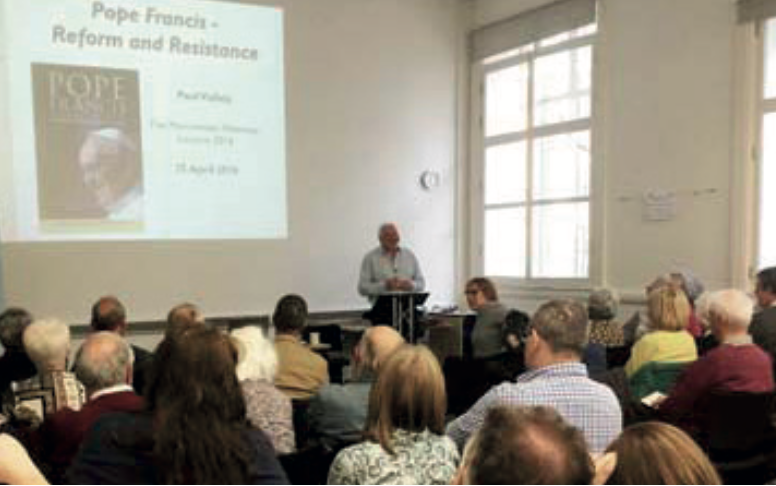
Paul Vallely giving the Manchester Newman Lecture, April 25th 2016
The Jesuit moral philosopher Fr Gerry Hughes gives a good example of that in the current edition of The Tablet17. He writes: Take, for example, the commandment to keep the Sabbath holy. In Catholic theology that has been interpreted in terms of attendance at Mass on Sundays and perhaps (though with less emphasis) observing Sunday as a day of rest. On the other hand, it is uncontroversially admitted, at least in general terms, that a person is not bound to attend Mass if it is very difficult or impossible for them to do so in cases of illness, or the unavailability of a Mass in a particular locality where an individual had to be. Similarly, Jesus in the Gospel is presented as saying that keeping the Sabbath holy does not require a person to avoid doing a work of mercy (for instance, healing a sick person, or gathering some berries in order to have something to eat on a journey). Was Jesus "changing the teaching of the Decalogue" or not?
Hughes sites similar theological developments to explain why Christians stopped refusing to serve in the armed forces, or ended the ban on lending money at interest which was formerly condemned as usury. Aristotle, Thomas Aquinas and John Henry Newman, Hughes explains, are at one in saying that universal principles will often have to be interpreted if we are to make good decisions about particular cases.
Flexibility and nuance
This is what riles Conservatives about Amoris Laetitia. It elevates this long-standing Catholic capacity for flexibility and nuance in pastoral practice, and sets it squarely alongside the law in full public view. Conservatives want the Pope to judge, not fudge, as they see it. "Perhaps Pope Francis should ask: Who am I to fudge?" asked one Conservative Catholic recently18. They want the Pope to pronounce so they can hide behind the magisterium – a failing which, interestingly, the thoughtful US conservative Ross Douthat has acknowledged in his 2015 Erasmus Lecture which he titled "A Crisis of Conservative Catholicism19".
In it he said: "It's easy to mock this sudden enthusiasm [among liberals] for papal authority. But a conservative Catholicism that became too quick to play the 'magisterium' card as a substitute for sustained argument must acknowledge that it's being hoisted on its own petard." Douthat's suggestion is that anyone talking about papal authority needs to place more "on the fullness of tradition rather than the words of just one Pope". Which is the kind of talk which got liberals into trouble under the papacies of Pope St John Paul II and Benedict XVI.
But Pope Francis wants a Big Tent with room for everyone, where disagreement is not dissent but dialogue. Previous popes have used post-synod exhortations to issue definitive new positions on the subject in hand. Francis has gone out of his way not to be definitive. Amoris Laetitia is, to conclude, a document which comes out of a three-year process involving an unprecedented questionnaire of lay people, two synods and a year of worldwide debate. It quotes from those synods more than 200 times as well as from numerous documents by bishops conferences around the world. It quotes from Protestants and secularists, too.
It speaks of the primacy of conscience, and of the need for discernment – that most Jesuit of practices from this Jesuit Pope. It speaks of the need for "each country or region" to "seek solutions better suited to its culture and sensitive to its traditions and local needs". He knows this will disconcert "those who prefer a more rigorous pastoral care which leaves no room for confusion". But Francis wants a more mature spirituality. He wants what the former Master General of the Dominicans, Fr Timothy Radcliffe, has called "a church for grown-ups20".
What this amounts to is the first practical application of the Second Vatican Council's call for a return to a more collegial church. This Pope is no longer monarch but a bishop among bishops. As primus inter pares he does not judge (or fudge) but rather is content to nudge. With this document Francis has shown himself to be the first true Vatican II pontiff.
Paul Vallely is a writer and consultant on international development, religion and ethics. He is a Director of The Tablet.